


From Ancient Gods to Internet Rulers: A Brief History of Cat Obsession
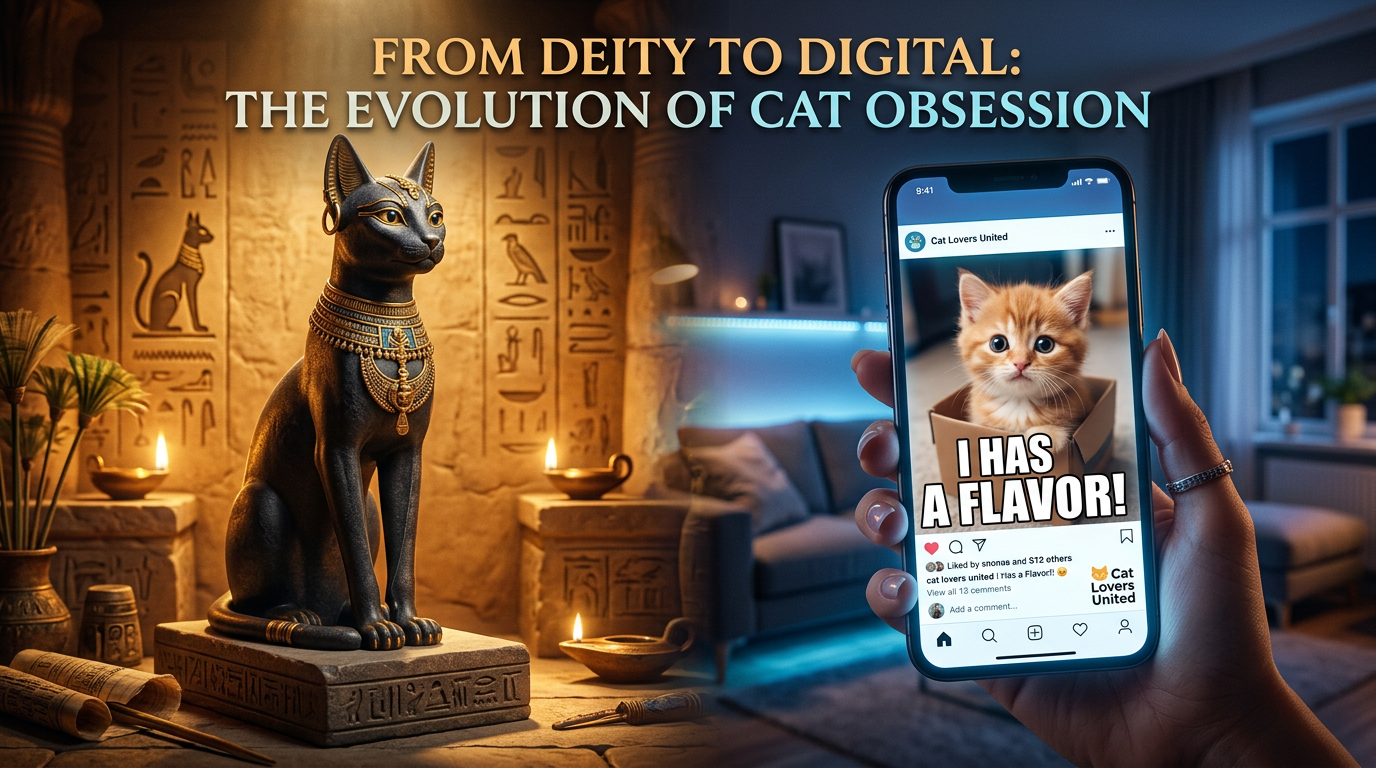
Scroll through any social media feed today and you'll find them: cats falling off couches, cats giving side-eye, cats dramatically overreacting to cucumbers. With over 6.5 billion cat videos on YouTube and cats occupying roughly 15% of all internet traffic, it's easy to assume our feline obsession is a modern phenomenon. But the history of cats and human civilization runs far deeper than any viral meme — spanning over 5,000 years of worship, persecution, and an improbable comeback that transformed a wild predator into the undisputed rulers of the internet.
The Original Cat People: Ancient Egypt
Around 3,000 BCE, the story begins in the Nile Valley. African wildcats, drawn by the rodents infesting grain stores, began lingering near human settlements. The Egyptians — sharp observers of nature — noticed these efficient hunters and welcomed them. What started as pest control evolved into something far more profound. Cats became sacred. The goddess Bastet, depicted as a lioness and later as a domestic cat, represented home, fertility, and protection. Killing a cat, even accidentally, was punishable by death. When a family cat died, the household shaved their eyebrows in mourning. Archeologists have discovered cat cemeteries with thousands of mummified felines — a testament to the depth of cat worship in ancient society.
Rome, the Middle Ages, and the Dark Times
As Egyptian influence spread through the Roman Empire, so did cats. Roman soldiers carried them north into Europe, where cats continued their practical roles as pest controllers. But the Middle Ages brought a brutal reversal. Cats — especially black cats — became associated with witchcraft, the devil, and heresy. In 1233, Pope Gregory IX issued the "Vox in Rama," linking cats to satanic rituals, and the persecution began. Cats were burned, drowned, and massacred across Europe for centuries. Ironically, this mass extermination of cats may have contributed to the spread of the Black Death — fewer cats meant more rats, and more rats meant more plague.
The Enlightenment Comeback
By the 17th and 18th centuries, reason returned. Cats were rehabilitated as useful barn and ship companions, protecting valuable goods and grain stores. Sailors and traders carried cats to the Americas and across colonial trade routes. The Victorian era elevated cat ownership to a mainstream domestic pleasure. Queen Victoria herself owned two Blue Persian cats, and her endorsement helped transform the cat from a working animal into a beloved household companion. The first cat show, held at London's Crystal Palace in 1871, drew thousands and cemented the cat's status as a respectable pet.
The 20th Century: Cats Enter Pop Culture
The 1900s saw cats explode into popular culture. Felix the Cat debuted in 1919 as one of the first animated stars. The musical "Cats" premiered in 1981 and became one of the longest-running shows in Broadway history. Garfield, launched in 1978, built a billion-dollar empire on lasagna and Monday-hating. Hello Kitty, created in 1974, became a global icon worth over $8 billion. The history of cats had entered its commercial golden age — but the biggest transformation was yet to come.
The Internet: Cat Domination 2.0
When the web went mainstream in the 1990s, cats were early adopters — or rather, early subjects. The legendary "I Can Has Cheezburger?" launched in 2007 and built LOLcats into a defining meme of the early internet. Grumpy Cat, with her permanently displeased expression, became a global brand worth an estimated $100 million. Maru, a Scottish Fold in Japan, holds the Guinness World Record for most YouTube views for a single animal. The pattern is unmistakable: every major internet platform — YouTube, Instagram, TikTok — becomes a cat platform within months of launch. Why? Because why we love cats is rooted in something deeper than entertainment. Cats are autonomous, unpredictable, expressive, and utterly themselves — qualities humans envy. In a world of curated perfection, a cat being unapologetically strange is deeply refreshing.
What 5,000 Years Tells Us
The arc of feline history is astonishing: from wild predator to deity, from deity to demon, from demon to companion, and from companion to global cultural dominance. No other animal has made this journey. Cats didn't evolve to please us like dogs did — they chose coexistence on their own terms, and we've been captivated ever since. The history of cats isn't just the story of a species — it's the story of human civilization's longest and strangest love affair.
Which era of cat history do you find most fascinating? Share in the comments — I'd love to know if you're Team Egypt, Team Victorian, or Team Internet Cat!
And if ancient Egyptian aesthetics meet modern cat love sounds like your style, explore our Cat Graphic Design Collection — inspired by 5,000 years of feline greatness.